# ================================================================
# Case Study 6 — Historical shape (ggplot2) + OC curves (base R)
# - One-sided sampling (Ac = 0), uniform axes across OC figures
# - Legend with AQL / LTPD / LQ20 values included
# - Four separate OC plots: n = 32, 50, 80, 125
# ================================================================

suppressPackageStartupMessages(library(ggplot2))
set.seed(123)

# -----------------------------
# 0) Setup (one-sided LSL case)
# -----------------------------
LSL <- 98.0
U   <- 102.0  # only for the illustrative historical distribution

# A left-skewed Beta(alpha, beta) on [LSL, U] when alpha > beta:
alpha_hat <- 8
beta_hat  <- 2.6

# Generator for the illustrative “historical” data:
# by construction, ALL values are >= LSL (no OOS).
r_hist <- function(n) LSL + (U - LSL) * rbeta(n, alpha_hat, beta_hat)

# -----------------------------
# 1) Historical distribution
# -----------------------------
hist_x <- r_hist(100000)
stopifnot(all(hist_x >= LSL))  # defensive check

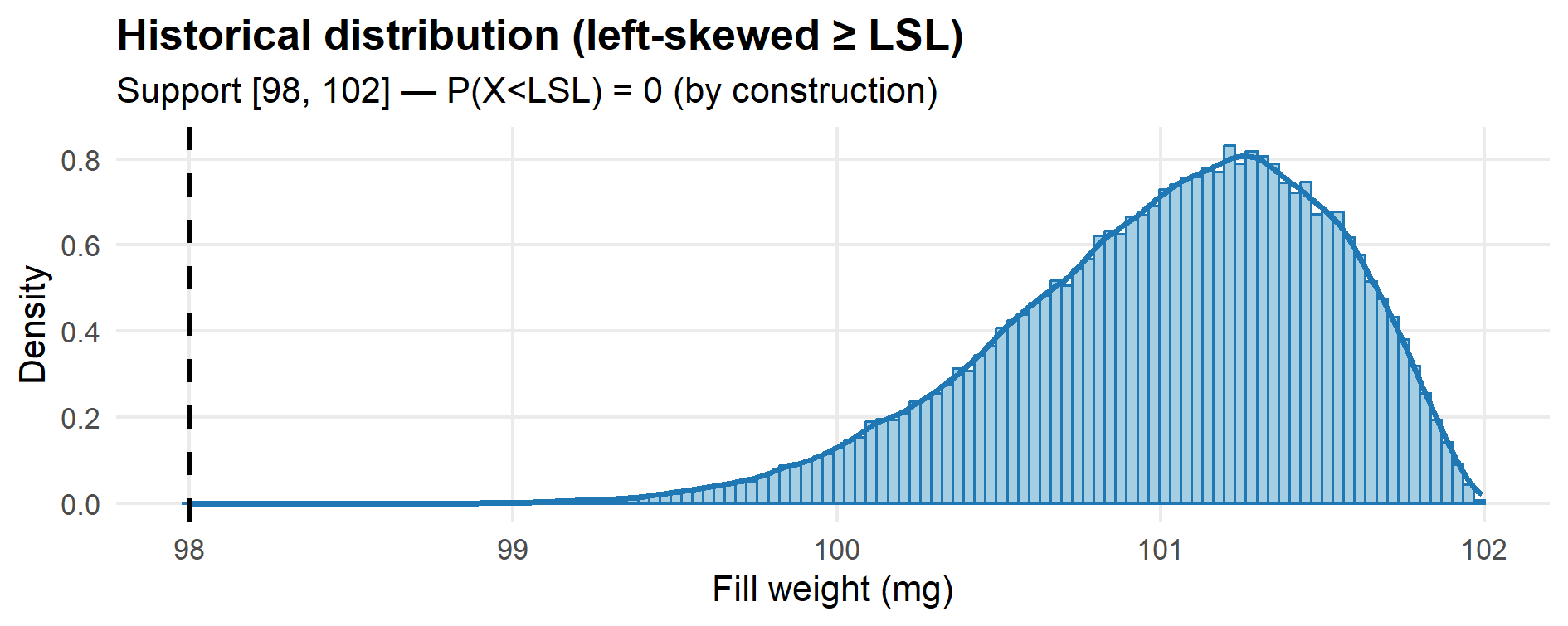
p_hist <- ggplot(data.frame(x = hist_x), aes(x)) +
  geom_histogram(aes(y = after_stat(density)),
                 bins = 120, fill = "#a6cee3", color = "#1f78b4") +
  geom_density(linewidth = 1.1, color = "#1f78b4") +
  geom_vline(xintercept = LSL, linetype = 2, linewidth = 1) +
  labs(title = "Historical distribution (left-skewed ≥ LSL)",
       subtitle = sprintf("Support [%g, %g] — P(X<LSL) = 0 (by construction)", LSL, U),
       x = "Fill weight (mg)", y = "Density") +
  theme_minimal(base_size = 13) +
  theme(plot.title = element_text(face = "bold"),
        panel.grid.minor = element_blank())

print(p_hist)
# ggsave("fig12_1_historical.png", p_hist, width = 10, height = 3.6, dpi = 150)

# -------------------------------------
# 2) OC settings and helper functions
# -------------------------------------
# Uniform axes across all OC plots (for visual comparability)
xlim_percent <- c(0, 16)    # x: 0–16% defectives
ylim_common  <- c(0, 0.40)  # y: Pa 0.00–0.40

# Grid of true defect rates p (in fraction). We will plot in percent.
p_grid <- seq(0, xlim_percent[2] / 100, by = 0.002)

# Monte Carlo reps for empirical Pa; increase if you want smoother dots
reps <- 20000

# Empirical acceptance probability at a given p
Pa_empirical <- function(n, Ac, p, reps = 20000) {
  # For Ac = 0, accept if K = 0 with K ~ Bin(n, p).
  mean(rbinom(reps, size = n, prob = p) <= Ac)
}

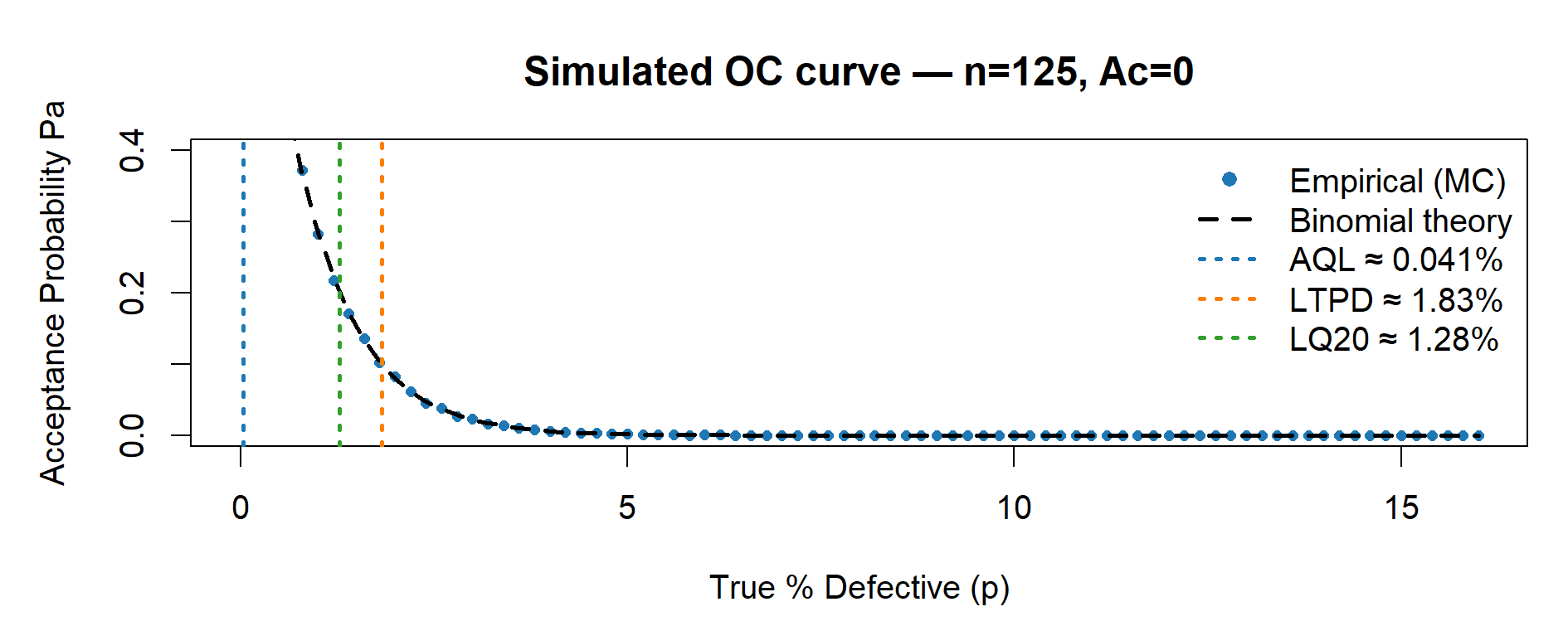
# One OC figure (base R): empirical (points) + binomial theory (dashed line)
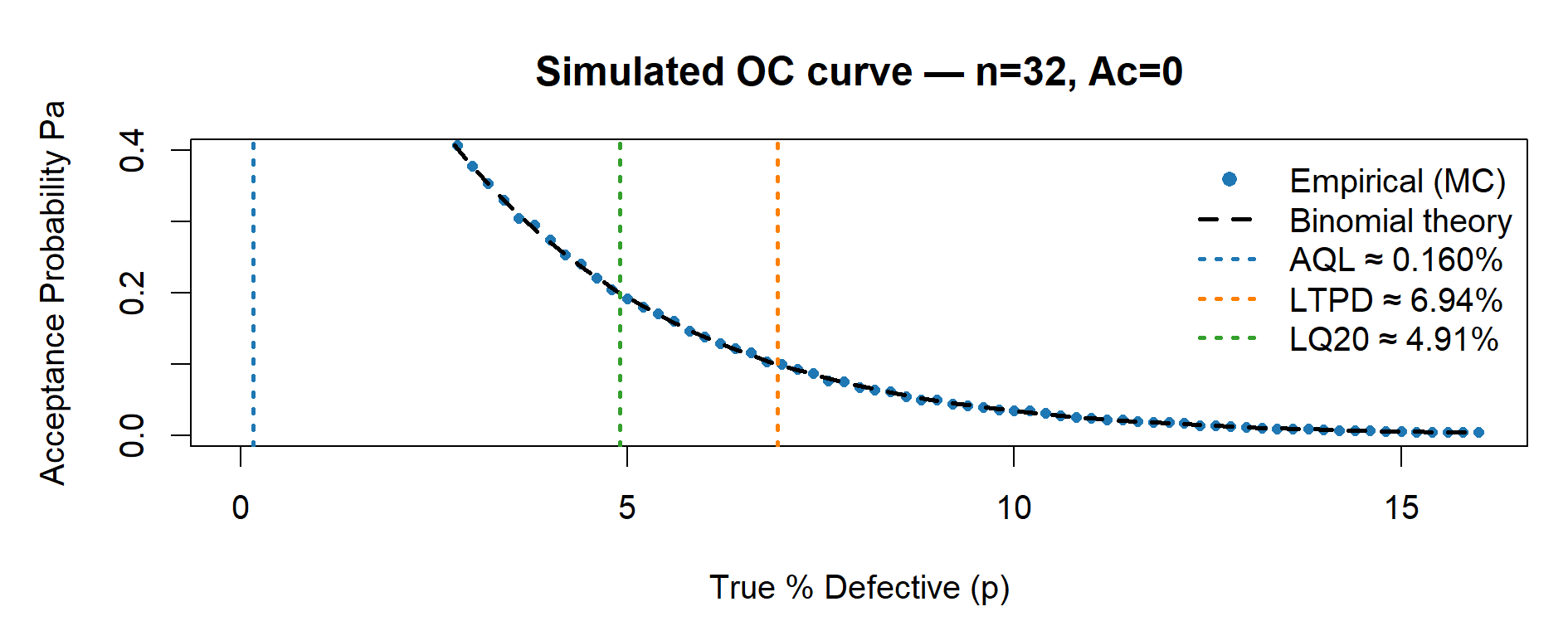
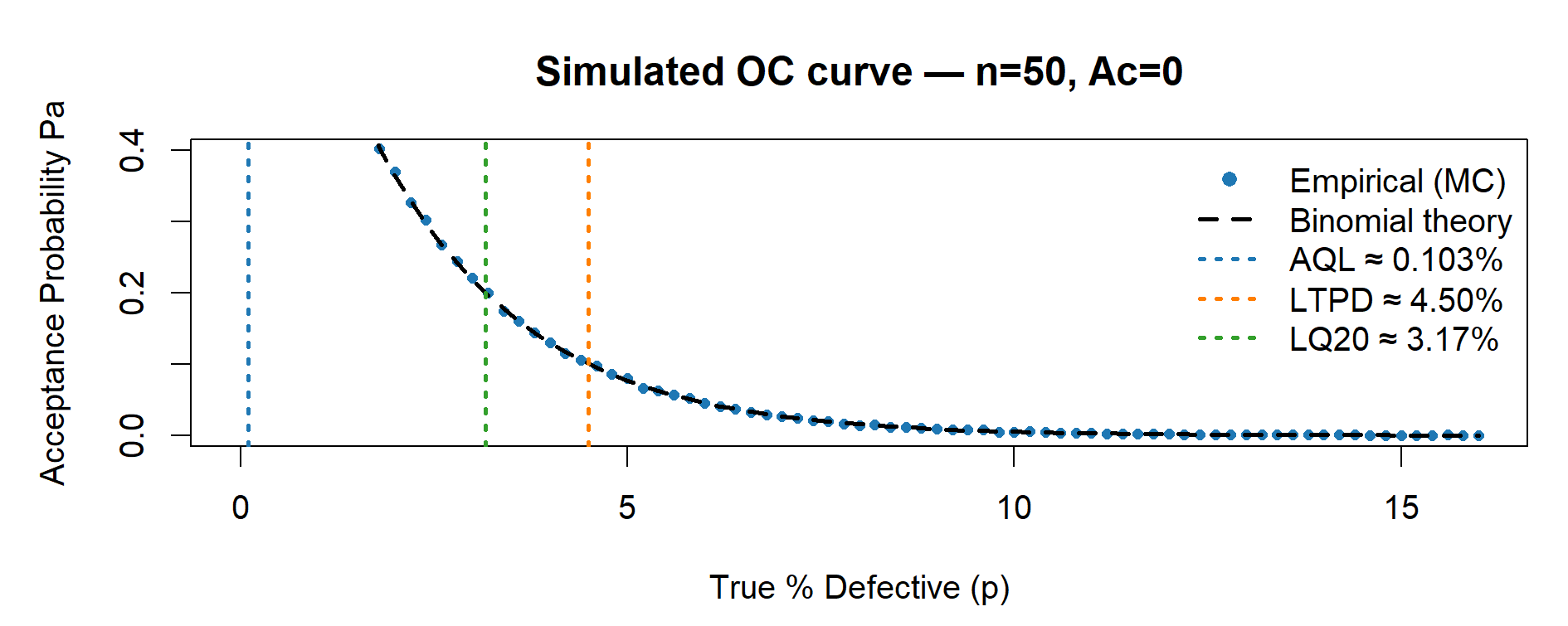
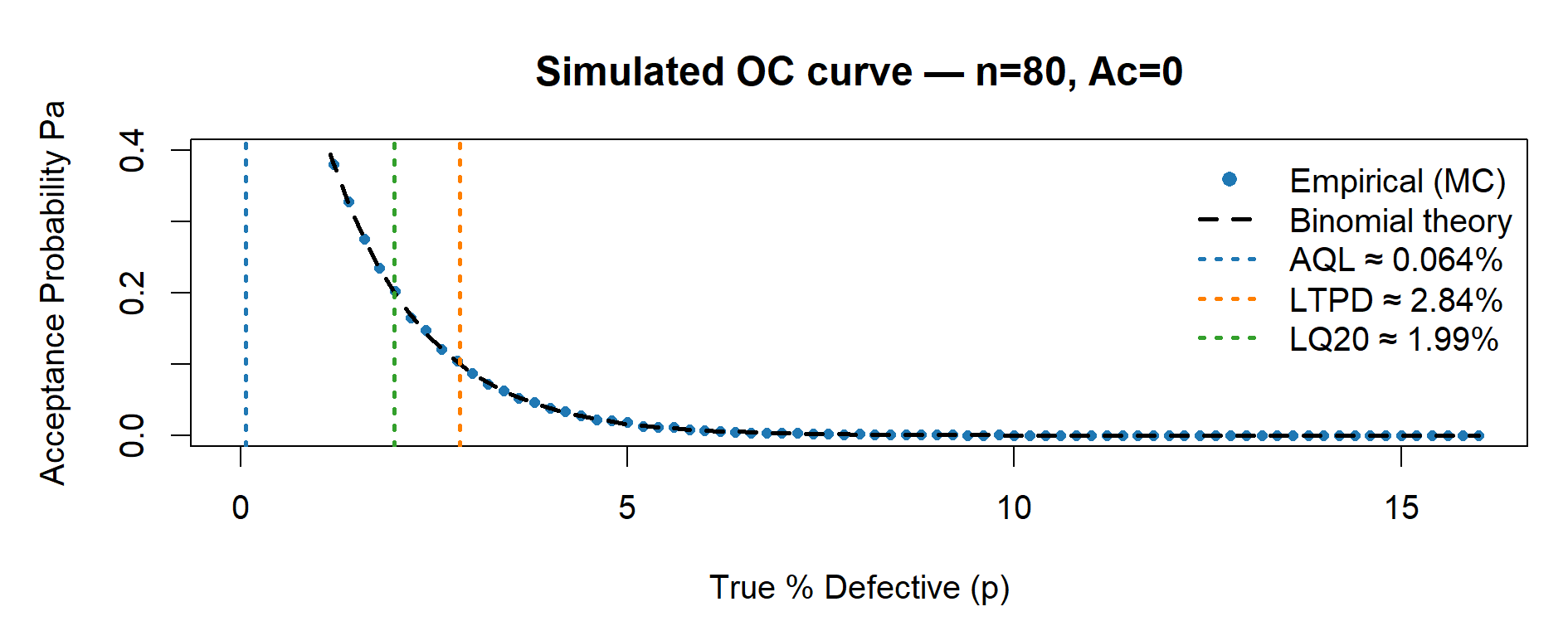
plot_OC_base <- function(n, Ac = 0L) {

  # Curves
  Pa_emp <- sapply(p_grid, function(p) Pa_empirical(n, Ac, p, reps))
  Pa_the <- pbinom(Ac, n, p_grid)  # For Ac=0, equals (1 - p)^n

  # Risk points (closed form for Ac = 0)
  p_AQL  <- 1 - 0.95^(1 / n)   # Pa ~ 0.95
  p_LTPD <- 1 - 0.10^(1 / n)   # Pa ~ 0.10
  p_LQ20 <- 1 - 0.20^(1 / n)   # Pa ~ 0.20

  # Plot
  par(mar = c(4.5, 4.8, 3.5, 1))
  plot(p_grid * 100, Pa_emp,
       type = "p", pch = 16, cex = 0.7, col = "#1f78b4",
       xlim = xlim_percent, ylim = ylim_common,
       xlab = "True % Defective (p)", ylab = "Acceptance Probability Pa",
       main = sprintf("Simulated OC curve — n=%d, Ac=%d", n, Ac))
  lines(p_grid * 100, Pa_the, lty = 2, lwd = 2, col = "#000000")  # Binomial theory

  # Vertical markers (thicker, color-coded)
  abline(v = 100 * p_AQL,  lty = 3, lwd = 2, col = "#1f78b4")  # AQL (blue)
  abline(v = 100 * p_LTPD, lty = 3, lwd = 2, col = "#ff7f00")  # LTPD (orange)
  abline(v = 100 * p_LQ20, lty = 3, lwd = 2, col = "#33a02c")  # LQ20 (green)

  # Single legend with numeric values
  legend("topright",
         legend = c("Empirical (MC)",
                    "Binomial theory",
                    sprintf("AQL \u2248 %.3f%%", 100 * p_AQL),
                    sprintf("LTPD \u2248 %.2f%%", 100 * p_LTPD),
                    sprintf("LQ20 \u2248 %.2f%%", 100 * p_LQ20)),
         col    = c("#1f78b4", "#000000", "#1f78b4", "#ff7f00", "#33a02c"),
         pch    = c(16, NA, NA, NA, NA),
         lty    = c(NA, 2, 3, 3, 3),
         lwd    = c(NA, 2, 2, 2, 2),
         pt.cex = 1.0,
         bty    = "n")

  # Return the three key percentages (for tables)
  invisible(c(AQL = 100 * p_AQL, LTPD = 100 * p_LTPD, LQ20 = 100 * p_LQ20))
}

# --------------------------------------
# 3) Four separate OC plots (not a panel)
# --------------------------------------
risk_n32  <- plot_OC_base(32,  Ac = 0L)
risk_n50  <- plot_OC_base(50,  Ac = 0L)
risk_n80  <- plot_OC_base(80,  Ac = 0L)
risk_n125 <- plot_OC_base(125, Ac = 0L)

# Optional PNG export:
# png("fig12_2_OC_n32.png", 1400, 500, res = 130);  plot_OC_base(32);  dev.off()
# png("fig12_3_OC_n50.png", 1400, 500, res = 130);  plot_OC_base(50);  dev.off()
# png("fig12_4_OC_n80.png", 1400, 500, res = 130);  plot_OC_base(80);  dev.off()
# png("fig12_5_OC_n125.png",1400, 500, res = 130);  plot_OC_base(125); dev.off()

# --------------------------------------
# 4) Summary tables (percent + counts/1e6)
# --------------------------------------
# First, assemble a compact table with AQL, LTPD, LQ20 by plan:
risk_table <- rbind(
  `n=32,  Ac=0` = round(risk_n32,  3),
  `n=50,  Ac=0` = round(risk_n50,  3),
  `n=80,  Ac=0` = round(risk_n80,  3),
  `n=125, Ac=0` = round(risk_n125, 3)
)

# Then build a data.frame with “clean” column names (no spaces)
risk_df <- data.frame(
  Plan     = rownames(risk_table),
  AQL_pct  = risk_table[, "AQL"],
  LTPD_pct = risk_table[, "LTPD"],
  LQ20_pct = risk_table[, "LQ20"]
)

# Counts per 1,000,000 units (helps with interpretability on slides)
risk_df$AQL_cnt_1e6  <- round(risk_df$AQL_pct  / 100 * 1e6)
risk_df$LTPD_cnt_1e6 <- round(risk_df$LTPD_pct / 100 * 1e6)
risk_df$LQ20_cnt_1e6 <- round(risk_df$LQ20_pct / 100 * 1e6)

print(risk_df, row.names = FALSE)